is - "This picture takes place in Paris in those wonderful days when a siren was a brunette and not an alarm --- and if a Frenchman turned out the light, it was not on account of an air raid!"
...from Ninotchka, made in 1939.
After the credits, the film's prologue is viewed over a long shot view of the Place de la Concorde in Paris, and that's when you hear this line.
Wednesday, November 30, 2005


Sunday, November 27, 2005
Supercalifragilisticexpialidocious
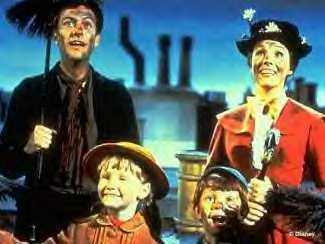
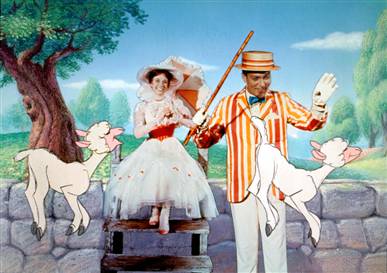
Mary Poppins:
Um diddle diddle diddle um diddle ay
Um diddle diddle diddle um diddle ay
It's...
Supercalifragilisticexpialidocious!
Even though the sound of it
Is something quite atrocious
If you say it loud enough
You'll always sound precocious
All:
Supercalifragilisticexpialidocious!
Um diddle diddle diddle um diddle ay
Um diddle diddle diddle um diddle ay!
Bert:
Because I was afraid to speak
When I was just a lad
My father gave me nose a tweak
And told me I was bad
But then one day I learned a word
That saved me achin' nose
Bert, Mary Poppins and Chorus:
The biggest word I ever heard
And this is how it goes: Oh!
Supercalifragilisticexpialidocious!
Even though the sound of it
Is something quite atrocious
If you say it loud enough
You'll always sound precocious
Supercalifragilisticexpialidocious!
Um diddle diddle diddle um diddle ay
Um diddle diddle diddle um diddle ay!
Mary Poppins:
He traveled all around the world
And everywhere he went
He'd use his word and all would say
"There goes a clever gent"
Bert:
When Dukes and maharajas
Pass the time of day with me
I say me special word and then
They ask me out to tea
Bert, Mary Poppins and Chorus:
Oh..
Supercalifragilisticexpialidocious!
Even though the sound of it
Is something quite atrocious
If you say it loud enough
You'll always sound precocious
Supercalifragilisticexpialidocious!
Um diddle diddle diddle um diddle ay
Um diddle diddle diddle um diddle ay!
Mary Poppins:
So when the cat has got your tongue
There's no need for dismay
Just summon up this word
And then you've got a lot to say
But better use it carefully
Or it could change your life
The Perlie:
One night I said it to me girl
And now me girl's my wife!
The Perlie, Mary Poppins and Chorus:
Oh..
Supercalifragilisticexpialidocious!
Even though the sound of it
Is something quite atrocious
If you say it loud enough
You'll always sound precocious
Supercalifragilisticexpialidocious!
Um diddle diddle diddle um diddle ay
Um diddle diddle diddle um diddle ay!
Um diddle diddle diddle um diddle ay
Um diddle diddle diddle um diddle ay
It's...
Supercalifragilisticexpialidocious!
Even though the sound of it
Is something quite atrocious
If you say it loud enough
You'll always sound precocious
All:
Supercalifragilisticexpialidocious!
Um diddle diddle diddle um diddle ay
Um diddle diddle diddle um diddle ay!
Bert:
Because I was afraid to speak
When I was just a lad
My father gave me nose a tweak
And told me I was bad
But then one day I learned a word
That saved me achin' nose
Bert, Mary Poppins and Chorus:
The biggest word I ever heard
And this is how it goes: Oh!
Supercalifragilisticexpialidocious!
Even though the sound of it
Is something quite atrocious
If you say it loud enough
You'll always sound precocious
Supercalifragilisticexpialidocious!
Um diddle diddle diddle um diddle ay
Um diddle diddle diddle um diddle ay!
Mary Poppins:
He traveled all around the world
And everywhere he went
He'd use his word and all would say
"There goes a clever gent"
Bert:
When Dukes and maharajas
Pass the time of day with me
I say me special word and then
They ask me out to tea
Bert, Mary Poppins and Chorus:
Oh..
Supercalifragilisticexpialidocious!
Even though the sound of it
Is something quite atrocious
If you say it loud enough
You'll always sound precocious
Supercalifragilisticexpialidocious!
Um diddle diddle diddle um diddle ay
Um diddle diddle diddle um diddle ay!
Mary Poppins:
So when the cat has got your tongue
There's no need for dismay
Just summon up this word
And then you've got a lot to say
But better use it carefully
Or it could change your life
The Perlie:
One night I said it to me girl
And now me girl's my wife!
The Perlie, Mary Poppins and Chorus:
Oh..
Supercalifragilisticexpialidocious!
Even though the sound of it
Is something quite atrocious
If you say it loud enough
You'll always sound precocious
Supercalifragilisticexpialidocious!
Um diddle diddle diddle um diddle ay
Um diddle diddle diddle um diddle ay!
Click on the subject of this post for some pretty interesting information on "supercalifragilisticexpialidocious".
Before the Word
Corn is great, on the cob or otherwise,
but before corn in the ear there was life.
Fire is holy especially for Zoroastrians,
but before fire too there was life.
Before the bowstring and the flint arrow sang,
there was life.
The word is great,
yet there was life before the word.
We can't turn romantic and say
we were into bird speech or river-roar then,
into the silence of frost
or the language of rain.
But forest speech and swamp speech
came through easier to us.
When lightning crashed,
the cry of the marsh bird was our cry,
and we flung ourselves to the other branch
like any other baboon.
As winter whined on windy cliff,
we shivered with the yellow grass.
In winter-dark a hundred eyes
flared yellow in the jungle scrub.
When seasons changed, blood coursed with sap
and flowered in meadows. We were at home.
Nor eyes nor bat cries bothered us.
What if we didn't know
a bat assessed reality
from the ricochet of its cry?
Though there were no words,
fear had a voice with many echoes.
Worship was quieter, adoration
spoke only through the eyes or knees.
What was it like before language dropped like dew,
covering the scuffed grass of our lives?
Keki N. Daruwala is an eminent poet and fiction writer.
He writes in English and lives in New Delhi.
but before corn in the ear there was life.
Fire is holy especially for Zoroastrians,
but before fire too there was life.
Before the bowstring and the flint arrow sang,
there was life.
The word is great,
yet there was life before the word.
We can't turn romantic and say
we were into bird speech or river-roar then,
into the silence of frost
or the language of rain.
But forest speech and swamp speech
came through easier to us.
When lightning crashed,
the cry of the marsh bird was our cry,
and we flung ourselves to the other branch
like any other baboon.
As winter whined on windy cliff,
we shivered with the yellow grass.
In winter-dark a hundred eyes
flared yellow in the jungle scrub.
When seasons changed, blood coursed with sap
and flowered in meadows. We were at home.
Nor eyes nor bat cries bothered us.
What if we didn't know
a bat assessed reality
from the ricochet of its cry?
Though there were no words,
fear had a voice with many echoes.
Worship was quieter, adoration
spoke only through the eyes or knees.
What was it like before language dropped like dew,
covering the scuffed grass of our lives?
Keki N. Daruwala is an eminent poet and fiction writer.
He writes in English and lives in New Delhi.
Sunday, November 20, 2005
Friday, November 18, 2005
A prostitute to her daughter - K. Satchidanandan
Dear child, say without shame
that I am your mother
and this city is your father.
Go, tell the chaste wives,
I teach their men how to love.
I offered myself
in place of a thousand women,
and became a saint.
Man, my child, is endless Desire,
you should cross that sea
the way I rose above my body.
Raise your head;
be my survivor, grow to be great.
You should have a tryst with tomorrow:
you should see the sun
that I could not.
I do not want to weep before Jesus
nor do I want Upagupta to weep before me.
Every night I turn red hot,
every morning I become gold.
I conquered lust;
you should transcend greed.
We are the bountiful Earth
and we, the giving Nature.
(Translated from Malayalam by the poet with Rizio Raj)
that I am your mother
and this city is your father.
Go, tell the chaste wives,
I teach their men how to love.
I offered myself
in place of a thousand women,
and became a saint.
Man, my child, is endless Desire,
you should cross that sea
the way I rose above my body.
Raise your head;
be my survivor, grow to be great.
You should have a tryst with tomorrow:
you should see the sun
that I could not.
I do not want to weep before Jesus
nor do I want Upagupta to weep before me.
Every night I turn red hot,
every morning I become gold.
I conquered lust;
you should transcend greed.
We are the bountiful Earth
and we, the giving Nature.
(Translated from Malayalam by the poet with Rizio Raj)
Tuesday, November 15, 2005
Words
 "When I use a word," Humpty Dumpty said, in rather a scornful tone, "it means just what I choose it to mean - neither more nor less."
"The question is," said Alice, "whether you can make words mean so many different things."
"The question is," said Humpty Dumpty, "which is to be master - that's all."
Sunday, November 13, 2005
Na aaj lutf kar itna ke kal guzar na sake
woh raat jo ke tere gesoo'on ki raat nahin
ye aarzoo bhi baRi cheez hai magar hamdam
visaal-e-yaar faqat aarzoo ki baat nahin
woh raat jo ke tere gesoo'on ki raat nahin
ye aarzoo bhi baRi cheez hai magar hamdam
visaal-e-yaar faqat aarzoo ki baat nahin
Grant me not so much bounty today that tomorrow
night, without your locks,
may be too wearisome.
Yearning is a great thing, O friend,
but union with the beloved is not just a matter of
longing.
night, without your locks,
may be too wearisome.
Yearning is a great thing, O friend,
but union with the beloved is not just a matter of
longing.
Wednesday, November 09, 2005
Delhi Times/Delhi Slimes
Today's "Delhi Slimes" has an article about our Blogger Meet.
TTG also has a post about the article.
Now, the thing about the article is that, well, one, that Delhi Times (now Slimes) has sunk the lowest they could ever go; and two, that this article completely and totally misinterprets everything that was said that day.
I'm so fuckin' furious!
The only lucky thing about it, as TTG says too, is that River's name in the article isn't her real name.
I so hope Vulturo posts this "James' " number on his blog!
Update: James' number- 9818205432
TTG also has a post about the article.
Now, the thing about the article is that, well, one, that Delhi Times (now Slimes) has sunk the lowest they could ever go; and two, that this article completely and totally misinterprets everything that was said that day.
I'm so fuckin' furious!
The only lucky thing about it, as TTG says too, is that River's name in the article isn't her real name.
I so hope Vulturo posts this "James' " number on his blog!
Update: James' number- 9818205432
Monday, November 07, 2005
...aur theek taraazu ke kaante par ardh satya

One of my friends was talking about Govind Nihalani's Ardh Satya the other day. :)
Couldn't help but remember the poem (by the same name) in the film. It was written by Dilip Chitre.
chakravyuh mein ghusne se pehle
main kaun tha aur kaisa tha
yeh mujhe yaad hi na rahega
chakravyuh mein ghusne ke baad
mere aur chakravyuh ke beech
sirf ek jaanleva nikat-ta thi
iska mujhe pata hi na chalega
chakravyuh se nikalne ke baad
main mukt ho jaoon bhale hi
phir bhi chakravyuh ki rachna mein
fark hi na padega
marun ya maarun
maara jaoon ya jaan se maardun
iska faisla kabhi na ho paayega
soya hua aadmi jab
neend se uthkar
chalna shuru karta hai
tab sapno ka sansar use
dobara dikh hi na paayega
us roshni mein jo nirnay ki roshni hai
sab kuchh samaan hoga kya?
ek palde mein napunsakta
ek palde mein paurush
aur theek taraazu ke kaante par
ardh satya
main kaun tha aur kaisa tha
yeh mujhe yaad hi na rahega
chakravyuh mein ghusne ke baad
mere aur chakravyuh ke beech
sirf ek jaanleva nikat-ta thi
iska mujhe pata hi na chalega
chakravyuh se nikalne ke baad
main mukt ho jaoon bhale hi
phir bhi chakravyuh ki rachna mein
fark hi na padega
marun ya maarun
maara jaoon ya jaan se maardun
iska faisla kabhi na ho paayega
soya hua aadmi jab
neend se uthkar
chalna shuru karta hai
tab sapno ka sansar use
dobara dikh hi na paayega
us roshni mein jo nirnay ki roshni hai
sab kuchh samaan hoga kya?
ek palde mein napunsakta
ek palde mein paurush
aur theek taraazu ke kaante par
ardh satya
happy, happy, happy

"In that direction," the grinning cat said, waving its paw round, "lives a Hatter: and in that direction," waving the other paw, "lives a March Hare. Visit either if you like: they're both mad."
"But I don't want to go among mad people," Alice remarked.
"Oh, you can't help that," said the Cat. "We're all mad here. I'm mad. You're mad."
"How do you know I'm mad?" said Alice.
"You must be," said that Cat, "or you wouldn't have come here. By-the-bye, what became of the baby?"
"It turned into a pig," Alice answered very quietly.
"I thought it would," said the Cat, and vanished quite slowly, beginning with the end on the tail, and ending with the grin, which remained some time after the rest of it had gone.
"Well! I've often seen a cat without a grin," thought Alice; "but a grin without a cat! It's the most curious thing!"
Apparently...

Aanchal, you're a Golden Retriever!
No bones about it, you're a popular, fun-loving Golden Retriever. Adored by all and too cool for school, you're extroverted and enthusiastic. Your magnetic personality makes you the life of any bash. Since you're a true people-dog, you genuinely love all kinds of social gatherings. Going to parties, dinners, and other shindigs is the best way to add faces to your constantly growing circle of friends. But besides being on the social A-list, you're a confident, well-rounded pup who's definitely something to bark about. Pretty accomplished at anything you set your mind to, your sunny nature and winning ways make you one of everyone's favorite dogs. Woof!
I'M BACK!
...to stay! :)
The reason for my long-drawn absence was a mixture of nothing much to write about and having got a life. But, like I said...
I'm back!
Today:
Went to Blogger's Meet at the (supposedly quieter!) Barista Creme. Other bloggers in attendance: River, TTG and Vulturo, and a sweet guy called James (who I hear was there since 4:30 p.m.!). We talked and had nice coffees.
More on today's Blogger's Meet: Here and here.
Went back to Majnu ka Tila (after ages!) for some Beef Chilli and Tingmos and Shabhaklep. Was nice as always.
Contemplated going to Blues for a long overdue glass of Don't Dig It, but decided against it.
Came back home, played with Xena some, made a firm resolve to get back to blogging.
The reason for my long-drawn absence was a mixture of nothing much to write about and having got a life. But, like I said...
I'm back!
Today:
Went to Blogger's Meet at the (supposedly quieter!) Barista Creme. Other bloggers in attendance: River, TTG and Vulturo, and a sweet guy called James (who I hear was there since 4:30 p.m.!). We talked and had nice coffees.
More on today's Blogger's Meet: Here and here.
Went back to Majnu ka Tila (after ages!) for some Beef Chilli and Tingmos and Shabhaklep. Was nice as always.
Contemplated going to Blues for a long overdue glass of Don't Dig It, but decided against it.
Came back home, played with Xena some, made a firm resolve to get back to blogging.
Thursday, November 03, 2005
Monday, September 12, 2005
Aisi nazar se dekha us zaalim ne chowk par...
humne kaleja rakh diya chaaku ki nok par...
....meri angdaai na toote tu aaja...
Love the feeling of being in love
...constantly.
(Yes, Mom. It feels great. I know. :) )
Love how one person seems like the world for a moment. Love how no one else comes even close...hasn't come even close...for more than three years now. Love how it just doesn't seem like three years.
"Three years?? Really?!! It's been that long?"
"Three years? It's just been three years?"
Love how three years sometimes seems like such a long time, but it feels like much lesser.
Love the feeling of getting to know someone. Everyday. More and more.
The biggest lie you ever told,
your deepest fear about growing old,
the longest night you ever spent,
the angriest letter you never sent,
the boy you swore you'd never leave,
the one you kissed on New Year's Eve,
the sweetest dream you had last night
your darkest hour, your hardest fight...
....The saddest song you ever heard,
the most you said with just one word,
the loneliest prayer you ever prayed,
the truest vow you ever made,
what makes you laugh, what makes you cry,
what makes you mad, what gets you by,
your highest high, your lowest low - these things I want to know....
:) I feel happy. Constantly.
...Well, almost. :)
humne kaleja rakh diya chaaku ki nok par...
....meri angdaai na toote tu aaja...
Love the feeling of being in love
...constantly.
(Yes, Mom. It feels great. I know. :) )
Love how one person seems like the world for a moment. Love how no one else comes even close...hasn't come even close...for more than three years now. Love how it just doesn't seem like three years.
"Three years?? Really?!! It's been that long?"
"Three years? It's just been three years?"
Love how three years sometimes seems like such a long time, but it feels like much lesser.
Love the feeling of getting to know someone. Everyday. More and more.
The biggest lie you ever told,
your deepest fear about growing old,
the longest night you ever spent,
the angriest letter you never sent,
the boy you swore you'd never leave,
the one you kissed on New Year's Eve,
the sweetest dream you had last night
your darkest hour, your hardest fight...
....The saddest song you ever heard,
the most you said with just one word,
the loneliest prayer you ever prayed,
the truest vow you ever made,
what makes you laugh, what makes you cry,
what makes you mad, what gets you by,
your highest high, your lowest low - these things I want to know....
:) I feel happy. Constantly.
...Well, almost. :)
Thursday, September 08, 2005


Tuesday, August 23, 2005
Gaaaarfield!!
I love Garfield!
...Even more so since I've had Xena. Cats are all so like Garfield! :D
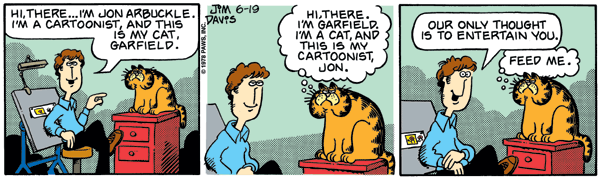
This is the first Garfield strip that Jim Davies made. It was published on the 19th of June 1978.

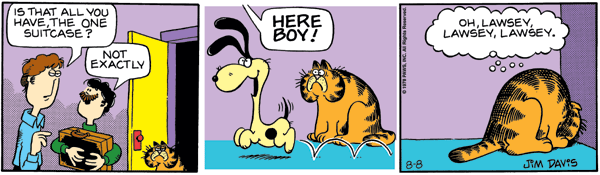
This one here was when Odie appeared for the first time - on the 9th of August 1978.
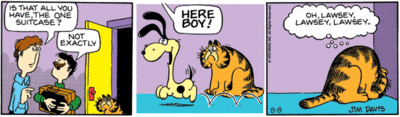
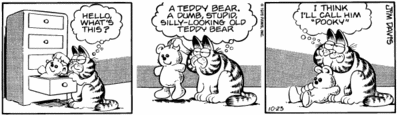
This, here, was the first time that Pooky made an appearance. The 23rd of October 1978.
And, this is today's Garfield strip:

...Even more so since I've had Xena. Cats are all so like Garfield! :D
This is the first Garfield strip that Jim Davies made. It was published on the 19th of June 1978.
This one here was when Odie appeared for the first time - on the 9th of August 1978.
This, here, was the first time that Pooky made an appearance. The 23rd of October 1978.
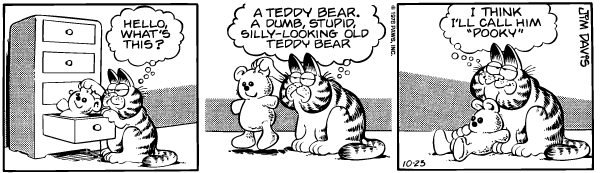
And, this is today's Garfield strip:

Monday, August 22, 2005
Beauvoir...Sartre...
"Our relationship was the greatest achievement of my life"
But did Simone de Beauvoir's scandalous open 'marriage' to Sartre make her happy, asks Lisa Appignanesi
Friday June 10, 2005
The Guardian

The Bogart and Bacall of existentialism ... De Beauvoir and Sartre in 1946.
'Women, you owe her everything!" So read the headline announcing Simone de Beauvoir's death in April 1986. It was a phrase repeated over and over at her funeral, where some 5,000 mourners gathered to pay tribute to the writer many consider the greatest French woman of the 20th century, author of The Second Sex, mother of the modern women's movement. De Beauvoir's ashes duly found their place next to those of Jean-Paul Sartre, her partner in life, though never in marriage. He had died six years almost to the hour before her, and her last book, Farewell to Sartre, was the only one he had never read prior to publication.
But did Simone de Beauvoir's scandalous open 'marriage' to Sartre make her happy, asks Lisa Appignanesi
Friday June 10, 2005
The Guardian

The Bogart and Bacall of existentialism ... De Beauvoir and Sartre in 1946.

'Women, you owe her everything!" So read the headline announcing Simone de Beauvoir's death in April 1986. It was a phrase repeated over and over at her funeral, where some 5,000 mourners gathered to pay tribute to the writer many consider the greatest French woman of the 20th century, author of The Second Sex, mother of the modern women's movement. De Beauvoir's ashes duly found their place next to those of Jean-Paul Sartre, her partner in life, though never in marriage. He had died six years almost to the hour before her, and her last book, Farewell to Sartre, was the only one he had never read prior to publication.
De Beauvoir had declared that whatever her many books and literary prizes, whatever her role in the women's movement or as an intellectual ambassador championing causes such as Algerian independence, her greatest achievement in life was her relationship with Sartre - philosopher, playwright, philanderer, born 100 years ago this month.

There is something mysterious in De Beauvoir's insistence. Given Sartre's other liaisons, and that this was the height of the women's movement, it seems to fly in the face of common sense. Yet the Simone who had flouted convention in the 20s by entering into an open liaison with an ugly, charismatic young unknown was not about to conform to expectations.
Whether we agree with her own startling assessment or not, it's clear that De Beauvoir was neither lying nor, as some misogynist commentators have argued, simply writing herself into a life more important than her own. After all, for 51 years, whether they were living close to one another or apart, she edited and, as Sartre himself put it, "filtered" his work, which he dedicated to her (some have ventured that, on occasion, she wrote it too). For 51 years, the conversations between them created ideas, books, and a bond which other passions enraged or enriched, but never altogether ruptured. It was, for De Beauvoir, an experiment in loving of which "existentialism" was the child.
When I was growing up in the 60s, Simone de Beauvoir and Jean-Paul Sartre were a model couple, already legendary creatures, rebels with a great many causes, and leaders of what could be called the first postwar youth movement: existentialism - a philosophy that rejected all absolutes and talked of freedom, authenticity, and difficult choices. It had its own music and garb of sophisticated black which looked wonderful against a cafe backdrop. Sartre and De Beauvoir were its Bogart and Bacall, partners in a gloriously modern love affair lived out between jazz club, cafe and writing desk, with forays on to the platforms and streets of protest. Despite being indissolubly united and bound by ideas, they remained unmarried and free to engage openly in any number of relationships. This radical departure from convention seemed breathtaking at the time.
De Beauvoir wrote about this in the autobiography she began to publish in the late 50s, after the scandalous success of her exposé of being female, The Second Sex, and her Goncourt prize-winning novel, The Mandarins, where she chronicles, among much else, her postwar affair with the American novelist Nelson Algren, whom she left in order to return to Sartre, abandoning passion for public responsibility.
De Beauvoir and Sartre met in 1929 when they were both studying for the aggregation in philosophy, the elite French graduate degree. De Beauvoir came second to Sartre's first, though the examiners agreed she was strictly the better philosopher and at the age of 21 the youngest person ever to have sat the exam. But Sartre, the future author of Being and Nothingness, was bold, ingenious, exuberant in his youthful excess, the satirical rebel who shouted, "Thus pissed Zarathustra" as he hurled water bombs out of classroom windows.
Sartre was the pampered son of a widowed mother. Educated in French and German by his pedagogue grandfather, the young Sartre, diminutive, wall-eyed, was corresponding in alexandrines by the age of 10 and something of an outcast at his provincial school. By the time he returned to Paris, he had learned to make up for his physical lacks by the sheer force of his personality. De Beauvoir was captivated by the intensity with which he also listened.
The young Sartre already saw himself as a Don Juan, a seducer who ruptured outworn convention, and whose presence revealed things in their fundamental light. Seduction and writing, he believed, had their source in the same intellectual process.
Late in life, he admitted that he had fantasised a succession of women for himself, each one meaning everything for a given moment. De Beauvoir had astonished him by agreeing to the experiment he had outlined. She accepted the freedom he insisted on and became its custodian.
"What we have," he said early on to De Beauvoir, "is an essential love; but it is a good idea for us also to experience contingent love affairs." Recording Sartre's proposal, De Beauvoir writes: "We were two of a kind, and our relationship would endure as long as we did: but it could not make up entirely for the fleeting riches to be had from encounters with different people."
It is difficult to underestimate the sheer adventurousness of this pact forged in 1929. Particularly on De Beauvoir's side, the break from accepted norms was monumental, as was the social stigma. For De Beauvoir, Sartre seemed only to be repeating what, from her father's example and bourgeois practice, she understood as a male prerogative. What was different about their relationships was that she, the woman, would be equally free to engage in other affairs. Then, too, there was Sartre's important dictum of "transparency" - the vow that they would never lie to each other the way married couples did. They would tell each other everything, share feelings, work, projects.
Yet in this lifelong relationship of supposed equals, he, it turned out, was far more equal than she was. It was he who engaged in countless affairs, to which she responded on only a few occasions with longer-lasting passions of her own. Between the lines of her fiction and what are in effect six volumes of autobiography, it is also evident that De Beauvoir suffered deeply from jealousy. She wanted to keep the image of a model life intact. There were no children. They never shared a house and their sexual relations were more or less over by the end of the war, though for much of their life and certainly at the last, they saw each other daily.
With the posthumous publication in 1988 of her letters to Sartre, a good proportion of them written during the war years when he was at the front and then a prisoner, gaps that were left out of the autobiography are filled in. What the letters express is not only De Beauvoir's overarching love for a man who is never sexually faithful to her, a man she addresses as her "dear little being" and whose work she loyally edits. They also underline the mundanity of De Beauvoir's early accommodation to his wishes, her acceptance of what many women would reject as demeaning, her dependence.
But this dependence is hardly simple or passive. It is a shared attachment from which power also comes - as De Beauvoir, in The Second Sex, shows it does for all women. From early on, Notre-Dame-de-Sartre, as the wits dubbed her, organises the comings and goings of Sartre's "contingent" women; she encourages, consoles, manipulates, and continues to do so until the very end for that loose grouping of friends and exes they called their "family". With a few exceptions, she performs whatever Sartre at the Front asks of her, including finding money for him, or having an affair.
The voyeuristic narration of the details of sexual passion for the other's entertainment, the ups and downs and seamy manoeuvres of these relationships give Sartre and De Beauvoir the aura of a latter-day Valmont and Merteuil, planning and reporting on their dangerous liaisons, analysing assaults and retreats, and deliberating over the propaganda which is to surround them. On top of all this are De Beauvoir's lesbian pursuits and her sharing of Sartre's partners. Bluestocking she might have been, but De Beauvoir was never averse to taking hers off, and then letting Sartre know.
It would be easy to condemn Sartre and De Beauvoir, to dismiss their sex lives as squalid and find therein reason to undermine their intellectual or political projects. This would be to miss the great edifice that De Beauvoir constructed out of their mutual experiment in living; the often gruelling honesty they both brought to bear on each other; and the ways in which the living and changing organism that was their partnership shaped both their philosophical writings and their fiction. It was clear to De Beauvoir that Sartre was a great thinker: thought needed tending. Happiness, that state she claimed she had a talent for, was not the point.
Then, too, there may be another very good reason why De Beauvoir thought her relationship was her greatest achievement. The Second Sex is her encyclopaedic and shocking account of woman's condition as "other" in a world where the norm, with all its overarching and defining power, was male. The book analyses how women have been made over in a world of male descriptions, the contortions performed in order to draw something from the secondary role, the mutilation, the pain. In the experiment of her relationship with Sartre, De Beauvoir took over the power of description. She writes him in and through her life. Maybe that was partly what she meant by her greatest achievement - alongside a generous love, respect and abiding loyalty.
Sunday, August 21, 2005
Subscribe to:
Posts (Atom)